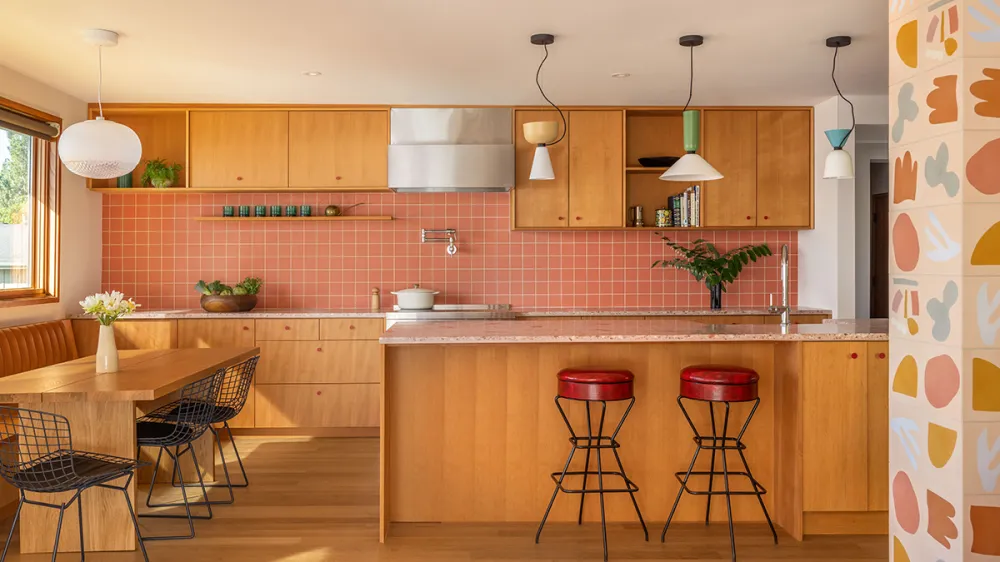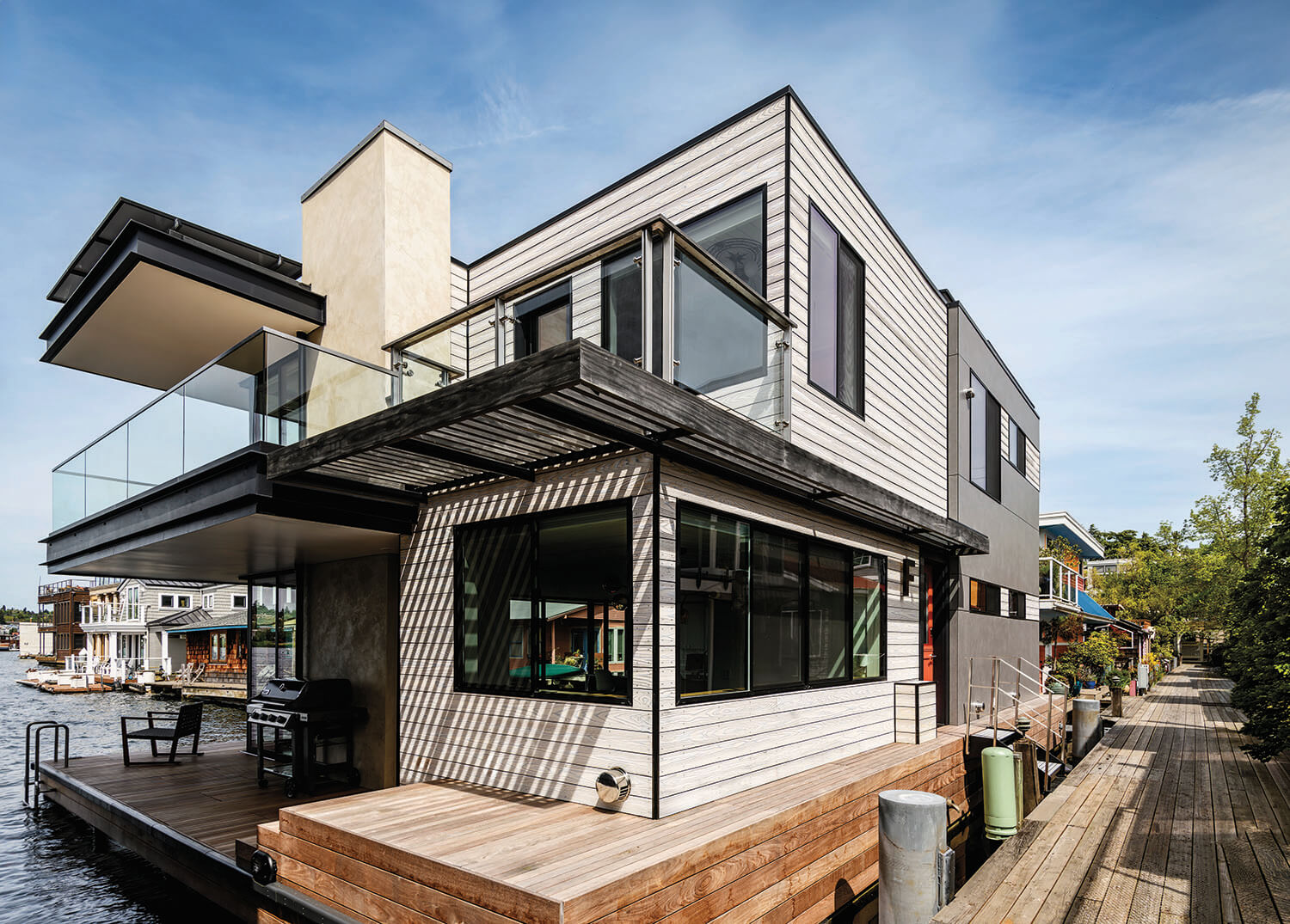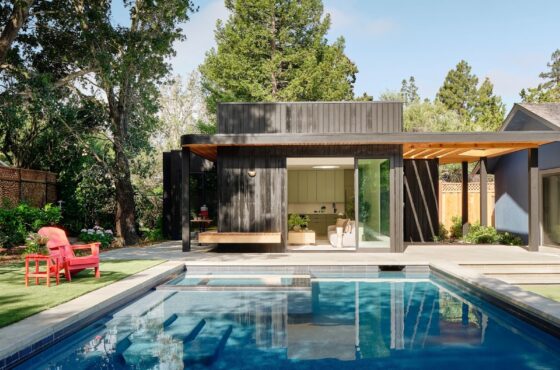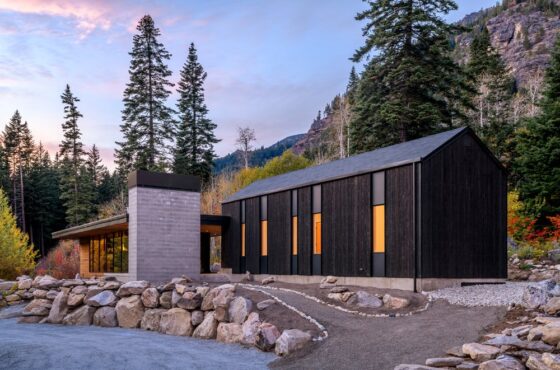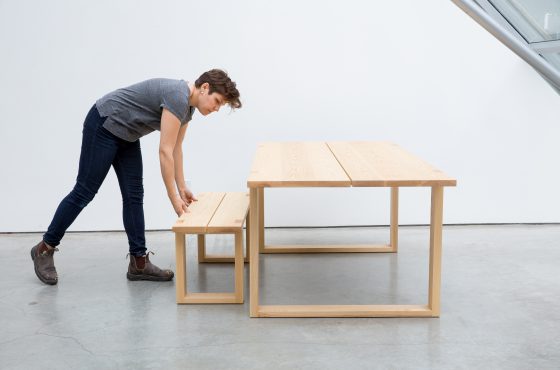
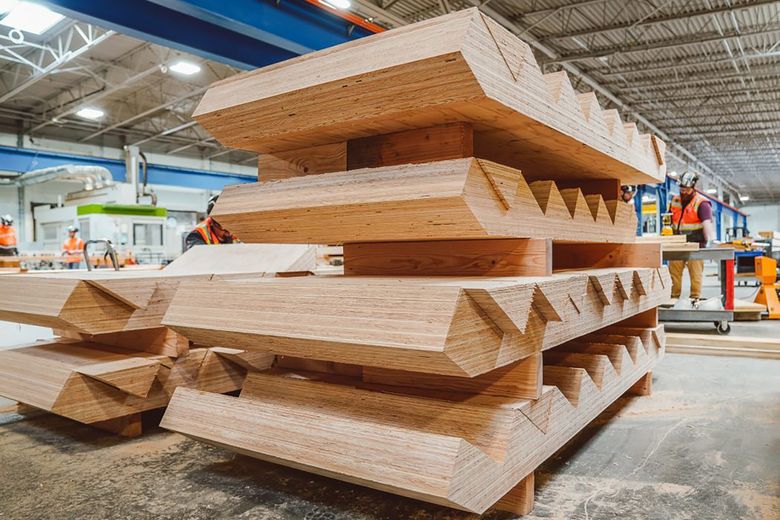
SPRINKLED ACROSS ARCHITECT Susan Jones’ office, next to three-dimensional architectural models and stacks of paper drawing sets, are blocks of wood in all colors and sizes. Material samples are not uncommon at architecture firms, but these pieces of wood at atelierjones on Capitol Hill aren’t typical lumber. Instead, a closer look at the blocks reveals they are actually composites — layers of wood glued together to form a single, solid piece.
This hybrid wood material is called mass timber. It may very well be the future of architecture.
“For most of the 20th century, the architecture community has been separated from the origins of the materials we build with,” Jones says as we flip through the pages of her new book “Light on Wood” (Birkhäuser), which traces her nearly 20-year journey to help shift the building industry away from carbon-emitting concrete and steel and toward carbon-retaining natural wood.
Jones, along with a growing chorus of architects, engineers and forestry experts in Seattle and beyond, believes building with wood is better for our cities, and for our forests.

And not just any wood. Most construction already banks heavily on wood in the form of small dimensional lumber; the mass timber movement is focused on much bigger components made by gluing layers of smaller pieces of wood together. Cross-laminated timber and glue-laminated timber, two of the most common mass timber building products today, can be used for the columns, beams, walls and floor decks of buildings.
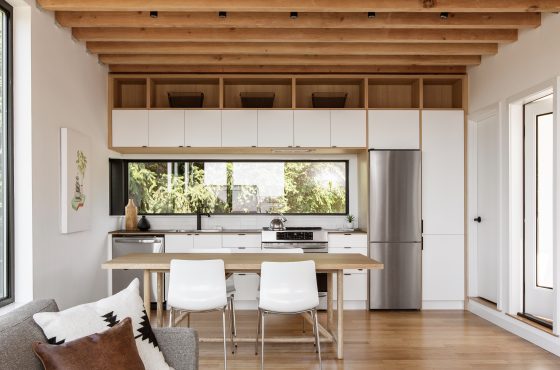
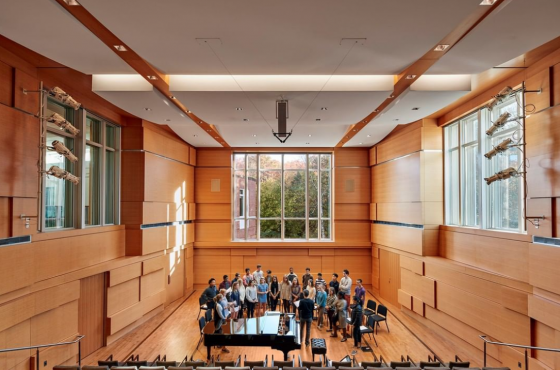
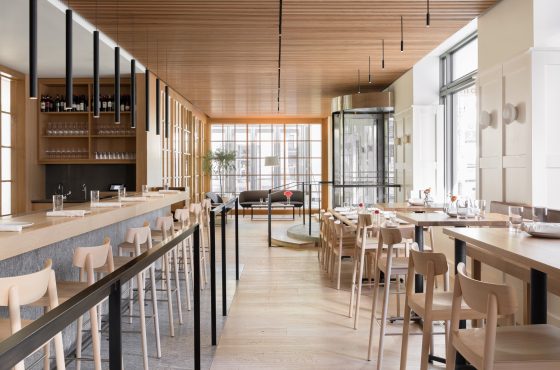
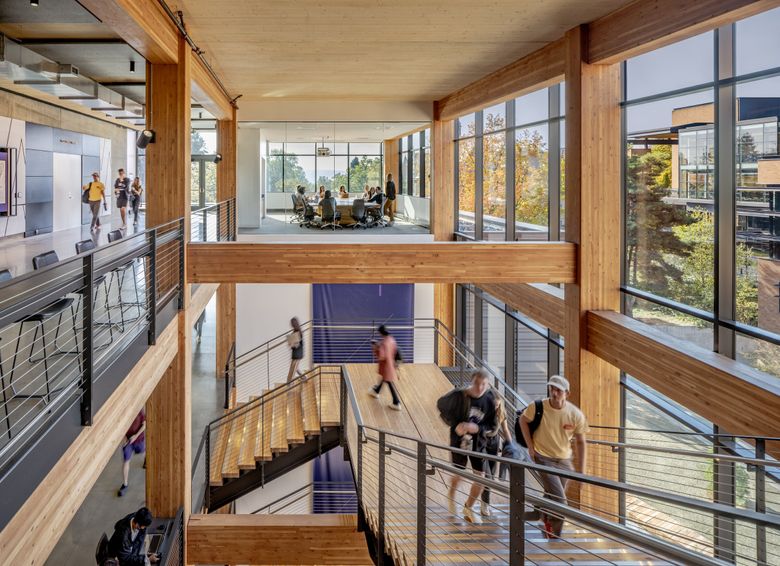
“In so much architecture today, the structure gets covered up,” says Jeremy Schoenfeld, an associate at LMN, another Seattle firm leading the local embrace of the new building approach. “Mass timber allows us to expose the structure and make it the beautiful thing about a building.”
Beauty aside, exposed structures mean using less material for surface finishes, further reducing a building’s carbon footprint. That’s a big deal. The construction industry accounts for about 40% of all global carbon emissions today.
Mass timber buildings offer a more sustainable path forward. Steel and concrete release large amounts of greenhouse gases — think of the energy required to mine and transport raw materials, then manufacture and ship finished products to a building site. Mass timber is different: Trees absorb carbon dioxide as they grow, and when they’re harvested and made into CLT, that carbon stays locked inside the wood, turning buildings into carbon sinks.
Locally and internationally, new building codes have been implemented in recent years to encourage more mass timber buildings, after a raft of studies proved that they don’t pose additional safety risks in a fire. Since 2020, Washington state has seen 95 mass timber projects either built or under construction, with another 73 in the design process. The mass timber revolution is already underway.
Surrounded by wood
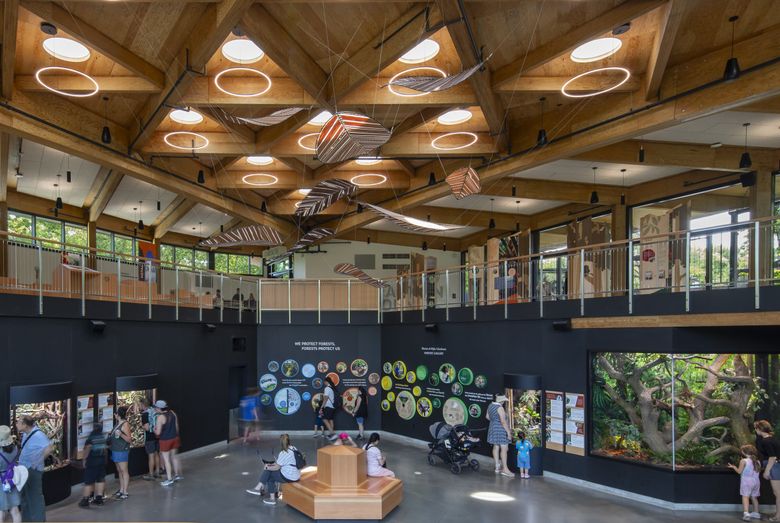
At LMN, architects use mass timber to make buildings that offer positive contributions to the environment. For their recent Forest Trailhead building, the first addition to the Woodland Park Zoo in nearly a decade, LMN designed a mass timber pavilion to house red pandas, tree kangaroos and other animals that call the forest home.
The building’s structure is made from mass plywood, a hyper local and cutting-edge engineered wood product made in Oregon from trees sustainably sourced from regional forests. The pavilion’s structure is visible from inside, where soaring, blond-colored wood beams intersect to form a triangular pattern. Circular skylights draw dappled light inside, much like light filtering through the overstory of a forest.
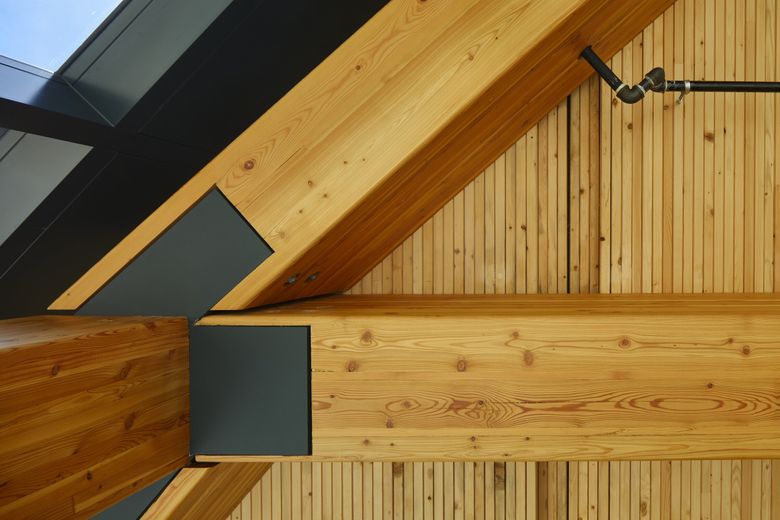
“We envisioned the building as an extension of the tree canopy,” says LMN associate partner Jennifer DuHamel, referencing the way mass timber buildings wrap their occupants in wood, creating a feeling akin to being in the forest.
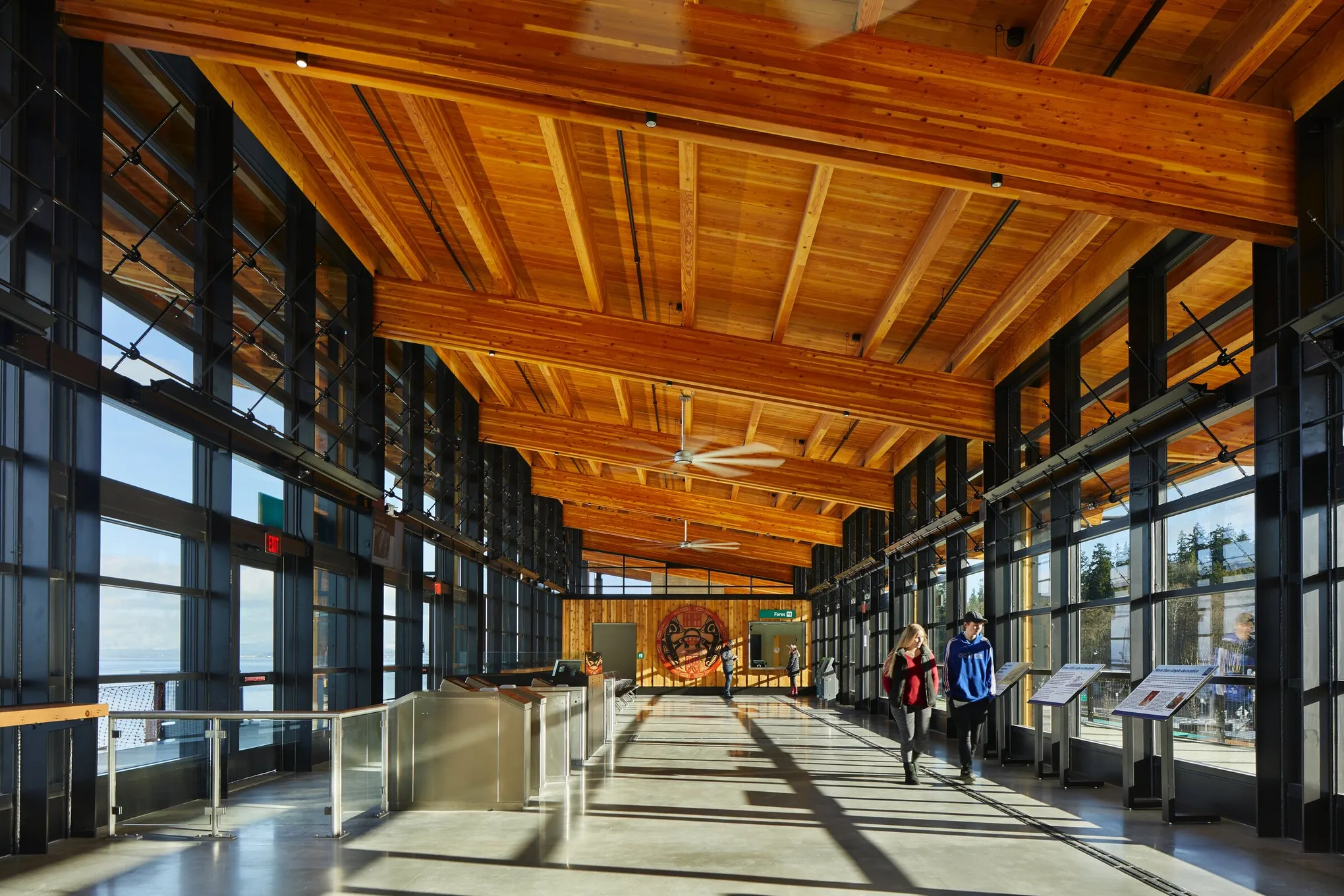
Forest Trailhead is the latest in a slew of large-scale mass timber buildings LMN has added to the local building stock in recent years, along with the Mukilteo Ferry Terminal, which was the first new Washington State Department of Transportation ferry terminal in 40 years; Founders Hall, the first mass timber building at University of Washington; and the Lakeview Office Building in Kirkland, the first mass timber office development on the Eastside. (Completed in 2013, the Bullitt Center by the Miller Hull Partnership was the first mass timber office building in Seattle.)
In addition to their lower carbon footprints, mass timber buildings can offer health and wellness benefits to the people who use them. “There’s research showing that office workers in mass timber buildings are happier and more productive, and that patients in hospitals with exposed wood have better outcomes,” Schoenfeld says. “It almost sounds like magic that a building material can have that much of an effect on you.”
Anyone who has walked through the Douglas firs, cedars and hemlocks of Washington’s forests has probably noticed how being among the trees slows your heart rate and improves your focus.
Last year, the University of Washington’s College of Built Environments partnered with Oakland nonprofit Carbon Leadership Forum to review more than 60 recent global studies on the health impacts of wood buildings. Across the board, the studies revealed that exposed wood in interior spaces helps reduce stress and improve overall well-being. Wood buildings, they concluded, have an unequivocal restorative effect on the human mind and body.
“We intuitively understand that we feel calm and good in spaces where we are surrounded by natural materials,” says Erica Spiritos, executive director of the Washington Mass Timber Accelerator, which promotes mass timber construction and research in the state.
The accelerator organization recently helped get mass timber recognized in Washington’s 2025 Comprehensive Climate Action Plan, which sets out a road map for the state to cut greenhouse gas emissions while stimulating the economy. Today, Spiritos is focusing on the potential of mass timber for schools and is trying to make it easier for districts to use the material. Alki Elementary in West Seattle, designed by Mahlum, which has offices in Seattle and Portland, is among the first schools built with mass timber; it welcomed its first class of students last week.
“In an age where we are inundated with technology, creating learning environments in mass timber is a great way to invest in the health and well-being of our children,” Spiritos says.
Forest benefits
Mass timber buildings are good for humans, but what about forests?
The challenges of logging are familiar in Washington, where the timber industry was a key driver of early 20th-century development. Our state once had the largest sawmills in the world, but its logging boom also led to clear cutting of large swaths of old-growth forests and, along with it, devastation of entire ecosystems.
Even today, perceptions of logging are closely intertwined with fears of deforestation and loss of old-growth trees, fears that were crystallized by the Northwest timber wars of the 1990s, when outcry from conservationists led to a massive cultural shift away from an extractivist, resource-focused mindset and toward leaving forest ecosystems untouched. Trees were no longer seen purely as an economic resource; instead, they were increasingly understood as integral to the health of our planet.
“We have an interconnected relationship with our forests,” says Spiritos, who notes that today lumber harvesting on Washington’s public lands is at a historic low.
Conservation is complex, however.
Today, many forests are unmanaged and unhealthy. The “no touch” mentality of the 1990s has left millions of acres of dense, second-growth forests where small trees fight for sunlight and fires run rampant. “We are currently losing more trees to fires than to harvest in Washington state,” Spiritos says.
“An unmanaged forest is not the same as a natural forest,” Jones says. It’s an important distinction, and one that Jones came to appreciate slowly after learning to care for a patch of conifer forest on Orcas Island that her grandparents bought in 1961.
Knowing the tangled, overgrown forest was prone to a fire that could quickly threaten the entire island, in 2010, Jones and her family began bringing their trees and land back to health. In the process, they learned that their forest, like many across the state, needed to be thinned to allow light to reach the forest floor.
“That creates both a healthy understory and a healthier overstory in the green branches above the trunks,” says Jones, noting that her land was overstocked with thin, weedy hemlock trees. Pulling out excess trees was essential for Jones’ land, and it’s something that millions of acres of our state’s public and private forests badly need.
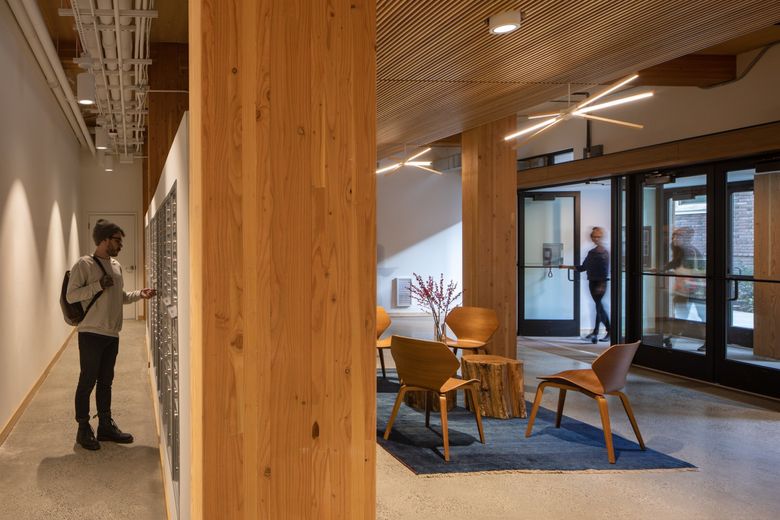
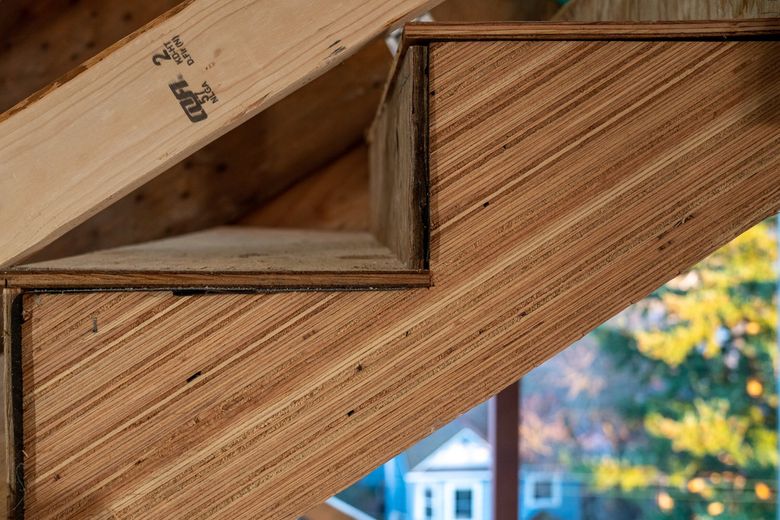
“Often there is a misconception of thinking about forestry as similar to mining,” says Indroneil Ganguly, associate professor in the School of Environmental and Forest Sciences at the University of Washington. “The fundamental difference is that in forestry, unlike mining, we can manage how we extract the resources so we support their replenishment. ‘Sustainable forestry’ means we are trying not to deplete our resource of trees.”
Derived from sustainably managed forests, mass timber does not put additional stress on our trees and lands.
Ganguly recently conducted a study, confirmed by the U.S. Forest Service and the state’s Department of Natural Resources, showing that in Washington’s public and privately managed forests, we are currently harvesting less than the new growth that is coming up. In other words, our forests are growing faster than we can manage.
Timber’s best use
If we are going to remove trees to make our forests healthier, mass timber proponents ask, then why not use that wood to its best and highest value?
“It’s just like food — the more you ultra-process something, the less healthy it is for you,” says principal John MacKay of the Miller Hull Partnership, a Seattle firm whose growing list of mass timber projects includes the new Irving R. Newhouse building, home of the state Senate and the latest addition to the Capitol Campus in Olympia; a housing and treatment facility for ALS patients in Spokane and several regional libraries in Oregon. “The same goes for building materials. Using them in their most basic, natural state is better for today, and better for their disassembly down the road.”
Rather than breaking down trees into pulp, cardboard boxes, paper products and small dimensional lumber (the most common products produced from forests today), mass timber allows the wood to remain visible in a construction product with huge environmental benefits.
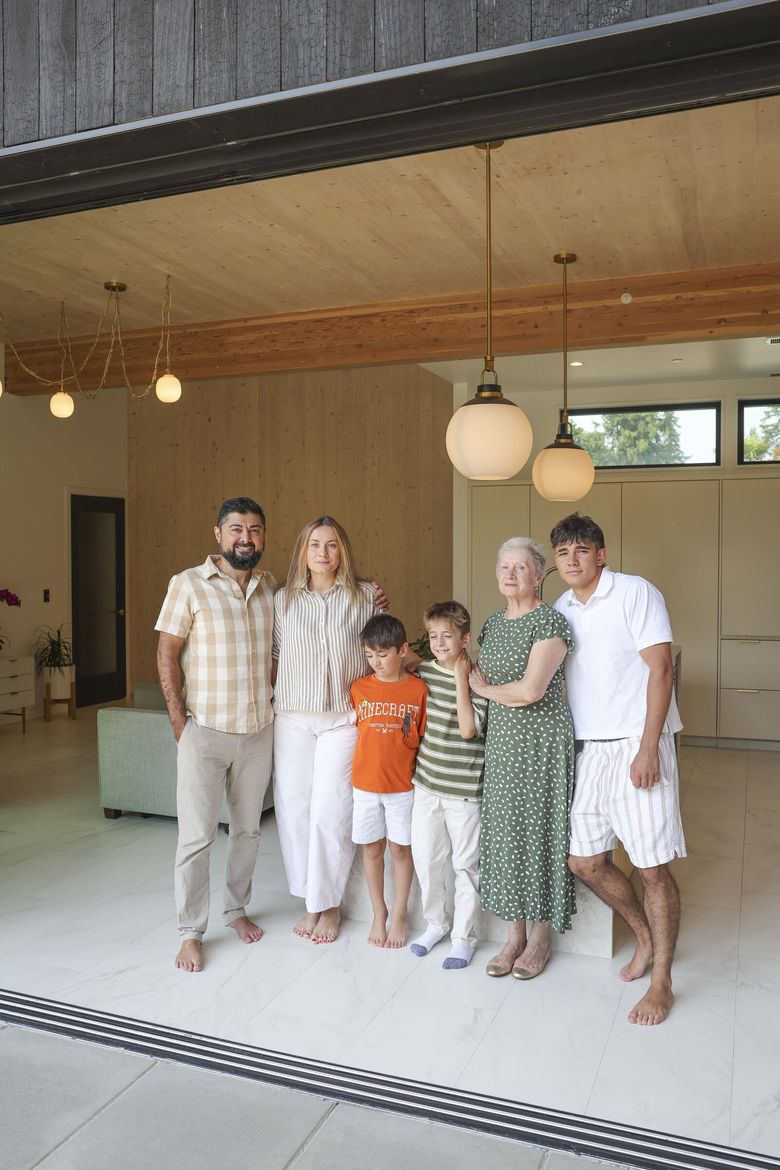
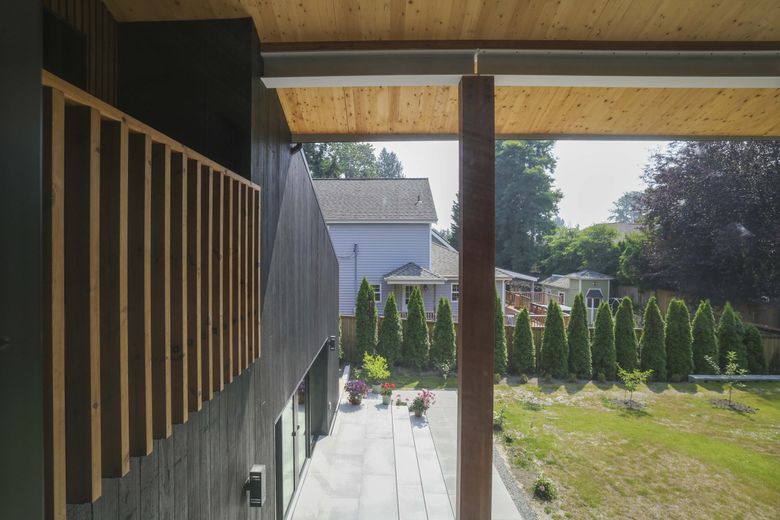
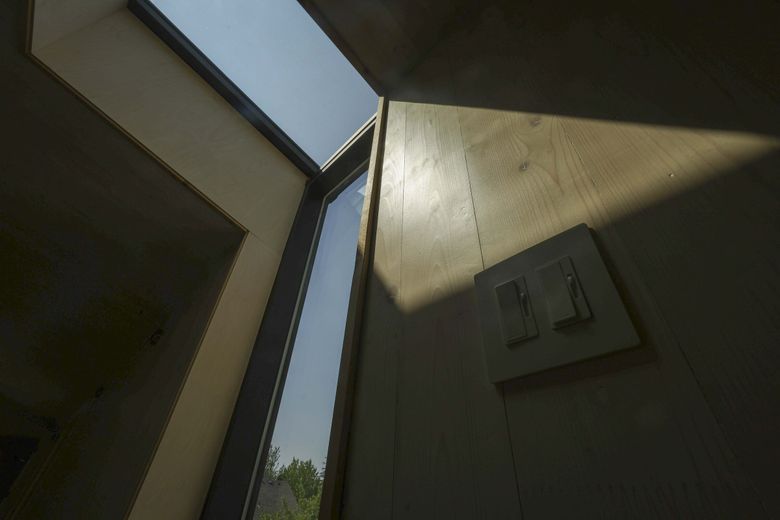
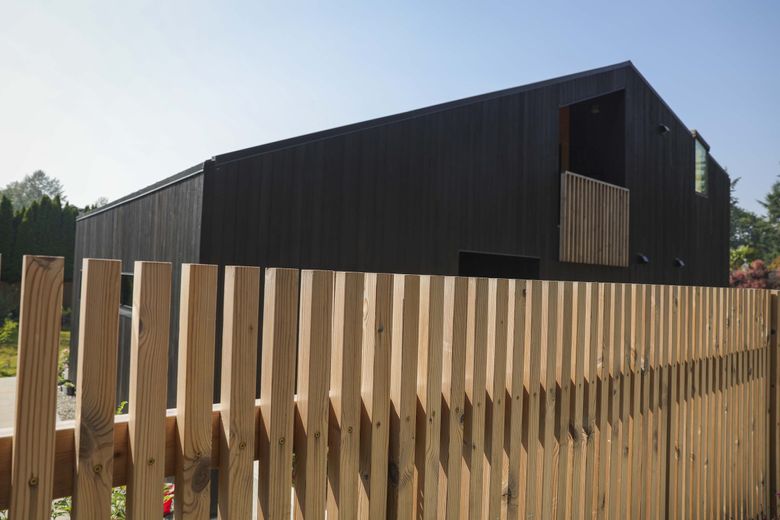
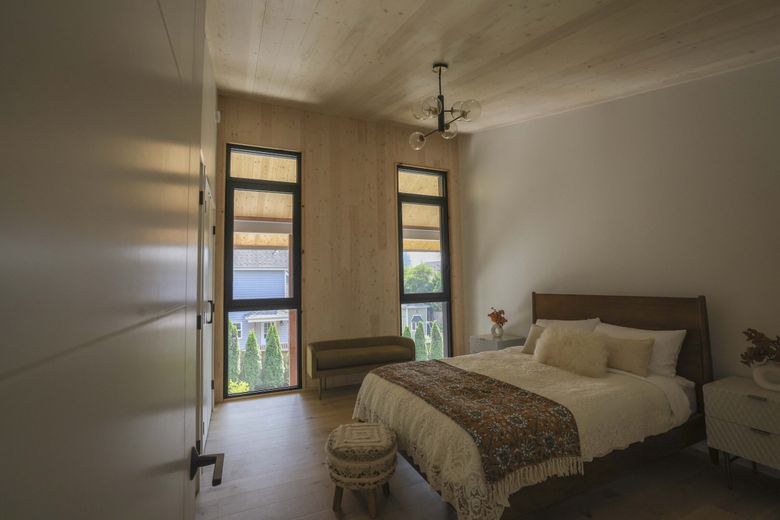
Jones is excited by the potential for mass timber to address two of today’s most pressing problems: climate change and the housing crisis.
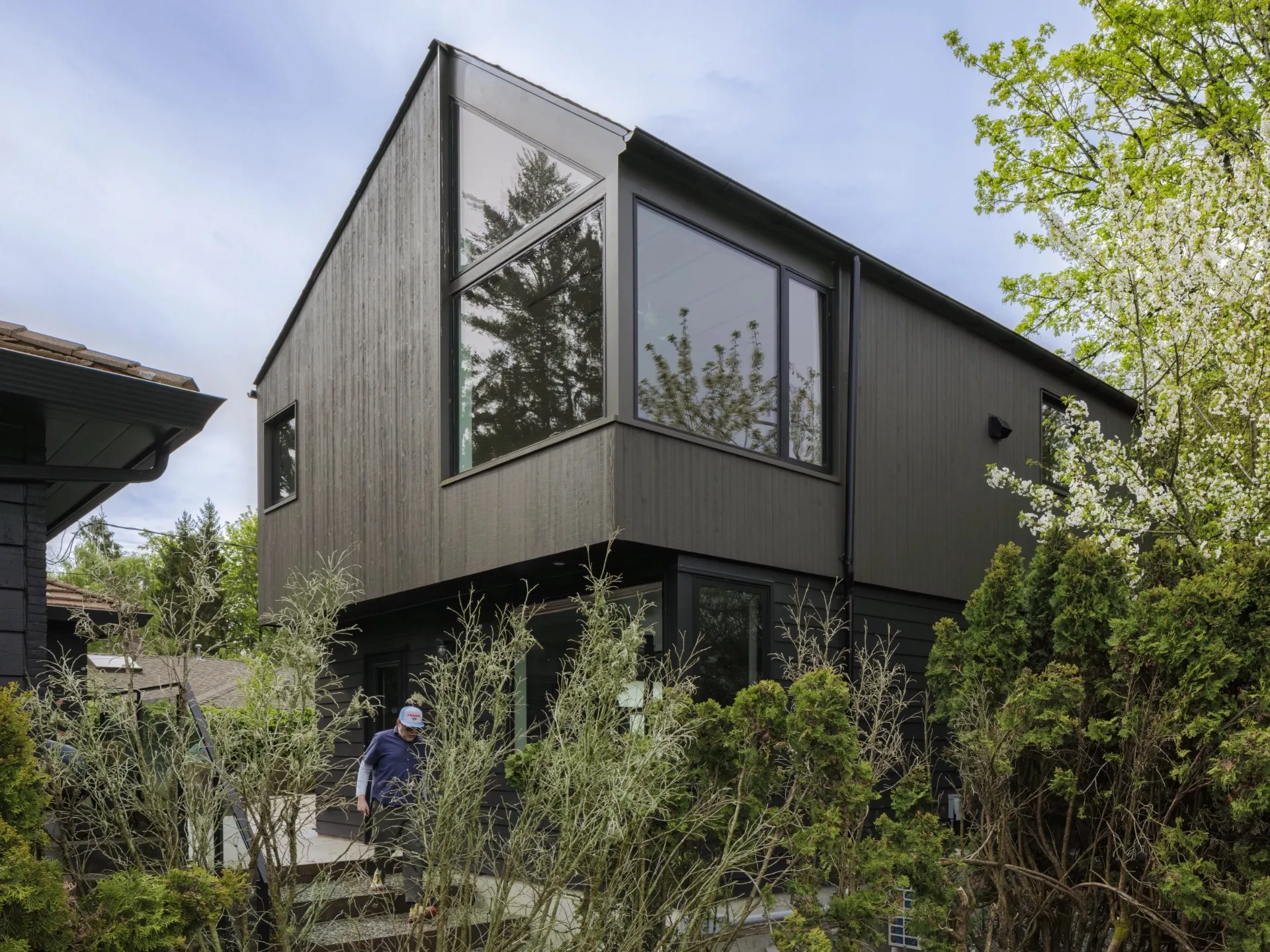
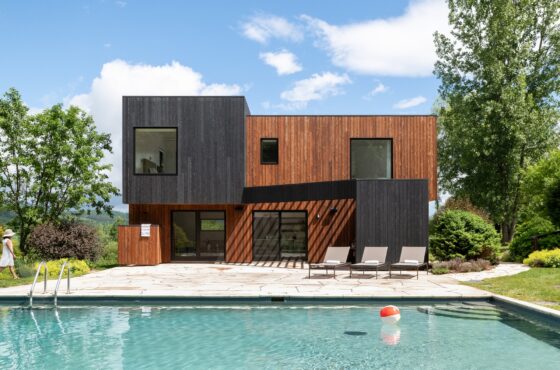
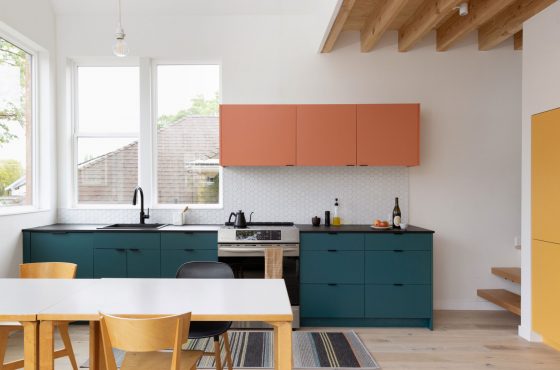
Jones’ first mass timber project was her own home, which she designed in 2015 as an experiment in cross-laminated timber. Now she’s almost done with two more single-family CLT houses in Shoreline and Kenmore.
Kenmore residents Susan Farzaliyeva and Abdurrahman Hussain sought out Jones’ expertise with mass timber when designing their new home. “CLT is more sustainable, and it’s beautiful,” Hussain says. “What’s not to love?”
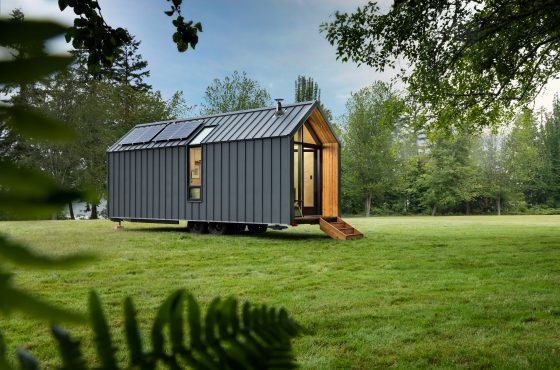
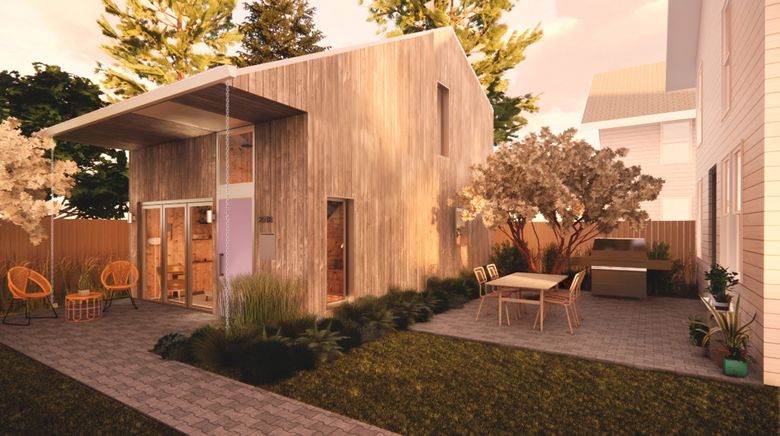
When it comes to mass timber housing, Jones is thinking both big and small scale. Atelierjones recently submitted a design for a mass timber accessory dwelling unit as part of ADUniverse 2.0, the City of Seattle’s open-access bank of ADU plans, which will be available to the public this November, helping to make ADUs more affordable and increase our local housing stock.
In 2024, the firm completed Heartwood, a multifamily housing block on Capitol Hill with 126 living units spread across eight floors. Heartwood was the first building in the nation to take advantage of recent changes in the International Building Code that allow for taller wood buildings — code changes that Jones helped implement.
Today, Seattle’s Office of Planning and Community Development is exploring new land use code zoning incentives to encourage developers to use mass timber for buildings as high as 18 stories – the current maximum allowed by International Building Code.
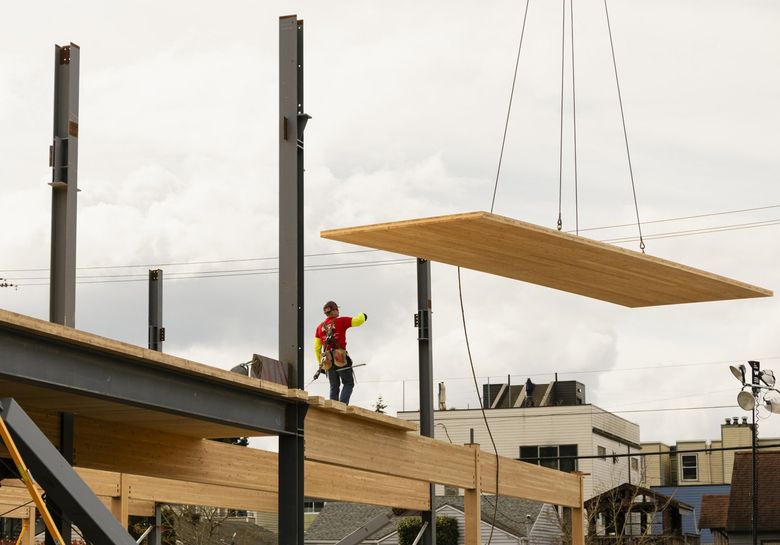
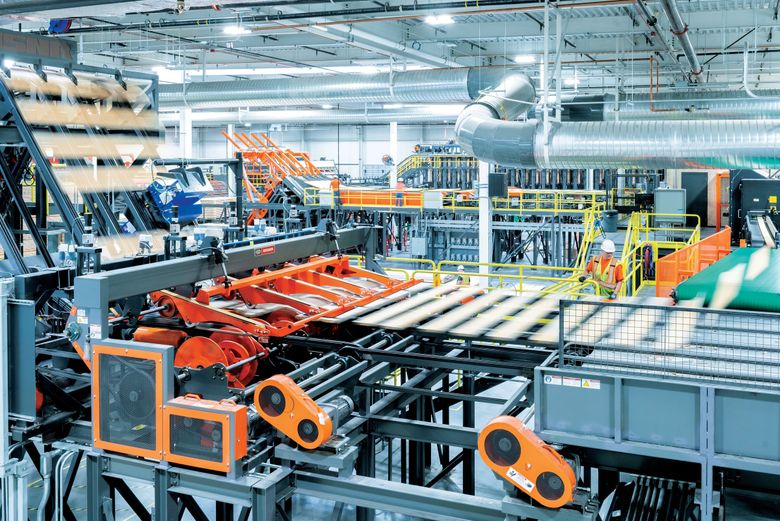
CLT pieces are manufactured off-site, then trucked in and craned into place. Because it’s essentially a prefabricated building system, mass timber construction projects are widely considered faster, cleaner and safer.
“The mass timber floor deck is immediately ready for workers to start working on, whereas a steel building needs to wait for every floor to be erected and then for concrete topping to be poured and cured,” Joe Mayo of Mahlum Architects says of one major time savings.
To meet the growing demand for mass timber buildings, architects are quick to note that we need more CLT manufacturers. “Ideally, we would have manufacturers local to each region that are tied to a forest that’s near them,” says architect Alex Zink of the Miller Hull Partnership. In this way, mass timber has the potential to grow rural economies in forested regions across the state.
But can our forests handle the demand? Yes, says UW’s Ganguly. A study he conducted last year for the Forest Products Society showed that mass timber consumption in the U.S. could increase by 6.5 million square meters in the next 30 years (an optimistic projection that represents a 10% increase in our current total lumber production), and our forests could easily meet the demand, two times over.
Washington has 22 million acres of forests, 47% of which is working forestland, so sustainable forest management could lead to increased mass timber building stock.”
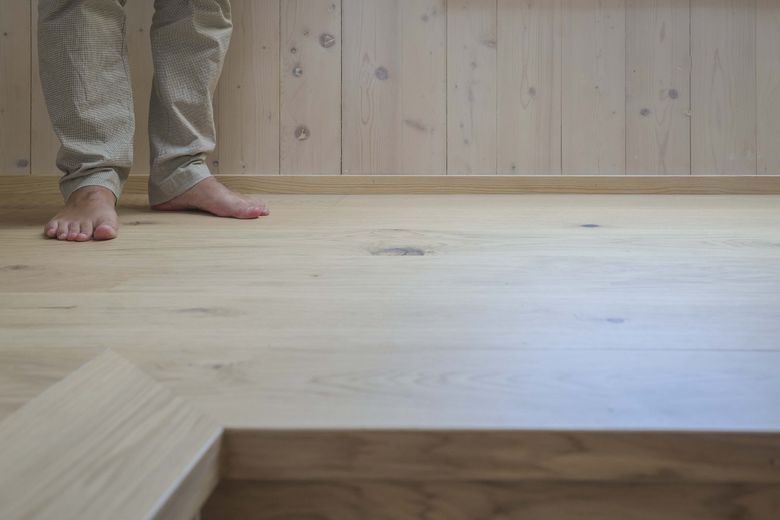
“Seattle’s architecture should reflect our region’s strength,” Jones says. “It should also represent our vision for how we can live closer to nature in our cities.”
Indeed, for Jones, the enduring potential of mass timber is that it reminds us why we’re trying to construct healthier buildings in the first place.
“Mass timber reinitiates and restarts a relationship between human culture and nature,” she says as she examines the newest wood sample in her office, a thermally modified hemlock product manufactured in Port Angeles.
“Mass timber is a way of reintegrating nature back into our built environment, and the deeper I go on this journey, the clearer it has become that mass timber is actually about the health of our forests. It’s about creating a healthier relationship between humans and the natural ecologies that exist all around us.”
Correction: An earlier version of this story misstated the mass timber building heights currently allowed by the City of Seattle. Eighteen stories are already allowed; the City is currently exploring land use code zoning incentives for developers, not taller mass timber buildings.